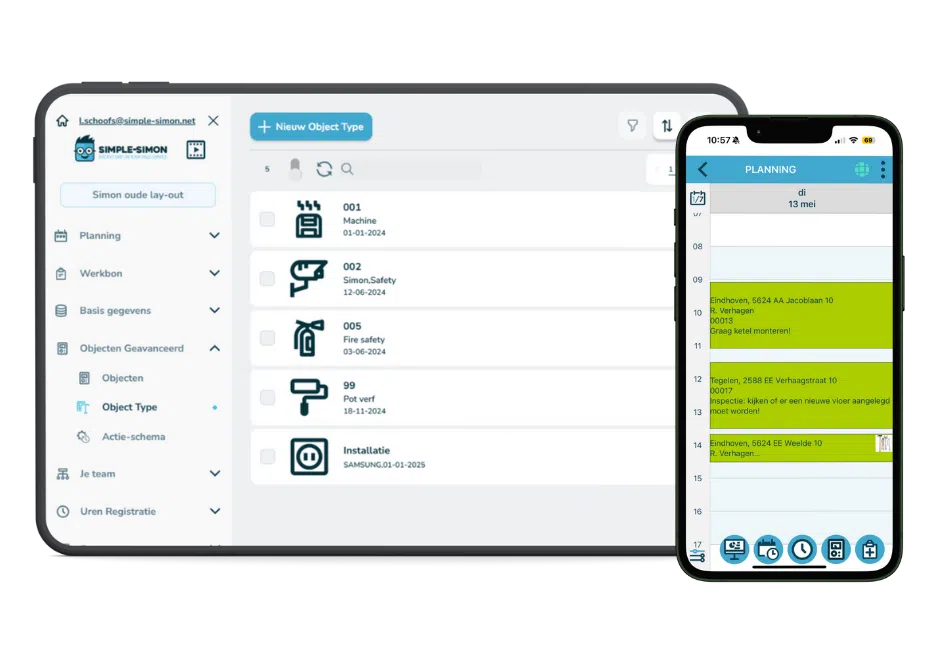
The future of field service management

Many companies with a field service team still work the way they did ten years ago. Excel for planning. Paper job sheets. WhatsApp for quick arrangements. It feels familiar. For now, it still seems to work.
But beneath the surface, a structural problem is growing: the world of field service is changing rapidly, while the way many companies manage their field teams stands still. That gap is starting to cost money. Not tomorrow. Already now, in your revenue, working time and customer satisfaction.

How field service will really change over the next 5 years

What used to be a supporting department is becoming a strategic core of the business. Field service is evolving from executional work into real-time, data-driven service. Within five years, this will no longer be a vision of the future, but standard practice.

Planning will largely be automated. Software takes skills, contract agreements, travel time and availability into account. For urgent jobs, schedules are recalculated in seconds. The role of the planner shifts from “arranging everything” to “adjusting and optimising”.

Technicians work fully mobile. No more paper job sheets, no forgotten notes in vans. Everything runs through smart apps: checklists, photos, digital signatures and direct synchronisation with the office.

Maintenance becomes predictive instead of reactive. Sensors and intelligent systems detect problems before they become visible. Downtime is prevented rather than solved.

And customers? They no longer want vague time slots. They expect transparency, updates and clarity. Just like parcel delivery, but for service.

The key developments of the next 5 years:

  • AI-driven planning and automatic rescheduling
  • Predictive maintenance based on IoT and data
  • Fully mobile field service workflows
  • Remote assistance and AR support
  • Real-time dashboards for performance and SLAs

The reality: the technology exists, but companies lag behind

The striking thing is: this technology is already available. The real stumbling block is not what is possible, but what companies dare to change. Many organisations remain stuck in familiar ways of working. Not because they lack vision, but because they fear complexity, painful implementations and high costs.

Large FSM systems promise a lot, but feel heavy. Long implementations, mandatory contracts, expensive licences and software that does not match how technicians really work. This creates hesitation. And so companies remain stuck in Excel. While there are systems that are made precisely for these companies. Software that adapts to the way of working, that does not require long and expensive implementation projects, but is genuinely easy to use

The silent cost of working with paper and Excel

This is where the pain is often underestimated. Paper and Excel are not free. They look cheap, but they hide structural losses. Minutes lost per job sheet. Hours disappearing through rescheduling. Errors that only become visible afterwards. Technicians drive unnecessary kilometres. They lack information when they arrive. Job sheets get lost. Invoicing is delayed by days or weeks. And every small friction point adds up.

Ten minutes of inefficiency per technician per day seems like nothing. But multiply that by twenty people and a full year, and you are quickly talking about tens of thousands of pounds in lost capacity. And that doesn’t even include the hours and days lost in the office.

Most companies actually know this. They feel the pressure. But changing feels big and risky, so they keep doing what they know. Today you often see the same patterns:

  • Plannings that have to be manually adjusted with every change
  • Job sheets that disappear in vans or in office folders
  • Invoices that can only be prepared days or weeks later
  • Hours of administration spent retyping job sheets into the accounting system

Why digitalisation often fails (and how it actually works)

Many companies have at some point looked at software for field service management and then walked away. Not because they lack ambition, but because it felt too heavy. Too many modules. Too much jargon. Too many promises that clash with the reality of the shop floor.

Many digitalisation projects fail not because of bad software, but because of the wrong choices.

  • Starting too big
  • Too complex
  • Too little focus on usability

When technicians see the system as “extra work”, the battle is lost before it begins. The solution is not more features, but better simplicity.

Where Simple-Simon makes the difference

That is why the approach of Simple-Simon works so well for field service organisations. Not because it has the most bells and whistles, but because it is built from real-world practice.

The software is quick to integrate. You do not have to wait months before going live. You start small and expand when you are ready. With Simple-Simon, your way of working leads – we adapt to you.

You are not tied into long contracts. No expensive onboarding costs, no commitments you will regret. You only pay for what you actually use.

Technicians understand the tool immediately. No extensive training required. No resistance. Just a logical, clear interface that helps them instead of slowing them down.

At the same time, the solution is future-proof. All the functionalities you need for modern field service are available, without becoming heavy or complex. Moreover, the solution is adapted to the needs of your company, not the other way around.

The real choice companies have to make now

The question is not whether field service will change. That change is already happening. The real question is: will you move with it, or will you fall behind? Will you keep relying on Excel while competitors steer their service in real time? Or will you choose control, visibility and scalability?

You do not have to make a big, risky leap. You do not have to sign multi-year contracts. You do not have to start a complex IT project. You can start smart. Small. Fast. Simple with Simple-Simon.

The future of field service management is clear

In conclusion, the future is clear: less paper, less chaos, less guesswork. More visibility. More control. More scalability. Companies that get this right today build a structural advantage. The rest pay the price, every single day.

Simple-Simon makes that step simple, affordable and future-proof. You can now try Simple-Simon free for 14 days, with no obligations.

Try for free